
|
|
|
|
England
Plan to boost jobs for newly qualified nurses and midwives
New measures to make it easier for NHS employers in England to take on newly qualified nurses and midwives have
been announced by the government.
The move comes after warnings that there are up to three times more graduates than vacancies in some areas of the
health service.
The aim is to free up trusts in England to recruit more easily by cutting red tape and simplifying regulations, including
allowing them to employ staff based on what they think they might need and before vacancies formally arise.
New measures would also see some support worker posts be temporarily converted to midwifery roles to create new
openings for graduates.
The Department of Health said the changes would tackle concerns about jobs after record numbers chose to train for
NHS professions during the pandemic - with fewer nurses and midwives quitting.
Source: BBC
|
100,000
new nurses have been added to
the workforce from the province of
Ontario, since 2018.
|
|
Source: Ontario Newsroom
|
|
|
|
15,700
new nursing graduates will join India's
workforce each year as the plan to launch
157 new nursing colleges has been
approved.
|
|
Source: The New Indian Express
|
|
|
|
29.8
million nurses existed globally in
2023, but a 5.8 million shortage remains.
|
|
Source: Mint
|
|
|
INDIA
Male nurses face stigma but are paid more
Nursing is often perceived as a "female profession," leading to male nurses experiencing occupational segregation and stigma.
But despite the need for increasing their strength, male nurses earn more than their female counterparts.
In India, male nurses are concentrated more in certain specialties, such as emergency departments and ICUs, with limited access or discouragement in other areas, including obstetrics and pediatrics, due to patient comfort and gender appropriateness.
The need of the hour to meet nursing shortages is to promote gender diversity and inclusivity.
By 2030, India is projected to have a total of 2.74 million nurses and midwives, but only 1.4 million are likely to be actively working in the health system.
Source: The New Indian Express
|
CANADA
Ontario investing $56.8 million to expand nursing enrollment
The Ontario government is continuing to deliver on its plan to protect the province's health-care system by investing $56.8 million to train 2,200 additional nurses. By expanding the number of nursing training and education seats at publicly assisted colleges and universities across the province, the government is building Ontario’s pipeline of highly skilled Nurse Practitioners, Registered Nurses, and Registered Practical Nurses that are needed to meet the growing need for more nurses in Ontario hospitals, long-term care homes, community health centers, and primary care clinics.
"Nurses are an integral part of Ontario's health-care system, providing life-saving and compassionate care when patients need it the most," said Nolan Quinn, Minister of Colleges, Universities, Research Excellence and Security. "Our government continues to expand nursing enrollment in our colleges and universities to ensure we are building the health-care workforce we need to protect Ontario health care and ensure people can continue to access excellent care, close to home."
Source: Ontario Newsroom
|

|
|
47,300
men work as nurses or health
visitors in the NHS, compared to
nearly 321,200 women.
|
|
Source: NHS England
|
|
|
|
40,000+
Filipinos are currently working in the
NHS,accounting for the second largest
ethnic group in the nursing workforce.
|
|
Source: National Institute of Health, UK
|
|
|
|
32%
workforce shortfall in Australia, with
only 97 mental health nurses for every
100,000 people.
|
|
Source: National Mental Health Commission, Australia
|
|
|
|
|
|
"From the beginning, the INSCOL team guided me through
each step of the process with professionalism and patience.
Their knowledge of the application requirements, timely
updates, and guidance made what could have been a
stressful process feel smooth. Thank you for all the
help & guidance."
Chetana Bhopal Aytan
Cebu, Philippines
Coronary Care Nursing
Seneca Polytechnic, Canada
Jan'26 intake
|
|
|
"My experience with INSCOL has been truly amazing.
The team's personal attention, clear guidance, and timely
updates made the entire process smooth and worry-free.
INSCOL is a great platform for nurses like me who are
seeking international opportunities. I’m so thankful for
their constant support and highly recommend them."
Loria Lino Antao
Goa, India
MSc Nursing Practice
University of Sunderland in London
Oct'25 intake
|
|
|
"Your team's prompt communication, thorough
documentation, and attention to detail ensure a smooth
and efficient experience. I am grateful for the time and
effort invested in my application, and I am thrilled with
the outcome. I will not hesitate to recommend your
services to others."
Dorabecc Kwakye - Yeboah
Ghana
Nursing in Canada - Transition for Internationally
Educated Nurses
Seneca Polytechnic, Canada
Sep'25 intake
|
|
| |
|
PHILIPPINES
Bleak job prospects for nursing graduates in the
Philippines
Ateneo de Manila University researchers warn that young
Filipinos graduating with a degree in nursing or medicine
face an uphill battle for stable employment, fair pay, and
meaningful roles in the local public health system.
This comes as the Philippines faces a massive shortage
of health professionals, with less than eight doctors per
10,000 people, below the international standard of 10 per
10,000, and over 127,000 vacancies for nurses,
particularly in rural areas and private facilities.
The researchers found that many new graduates feel lost
and unsupported when they join the workforce.
According to many of the researchers' interviewees, the
country's medical and nursing education system is too
focused on hospital-based care, leaving them ill-prepared
to handle community work, government systems, and
health programs.
As a result, fresh graduates are forced into a frustrating
dilemma: many are willing to serve in the public sector
but are either not qualified under strict civil service
requirements or are offered short-term contracts with no
job security or a clear path for career growth. Meanwhile,
private facilities struggle to match government pay scales,
and both sectors lose workers to better-paying jobs
abroad.
Source: Research Paper, Ateneo De Manila University

|
|
|
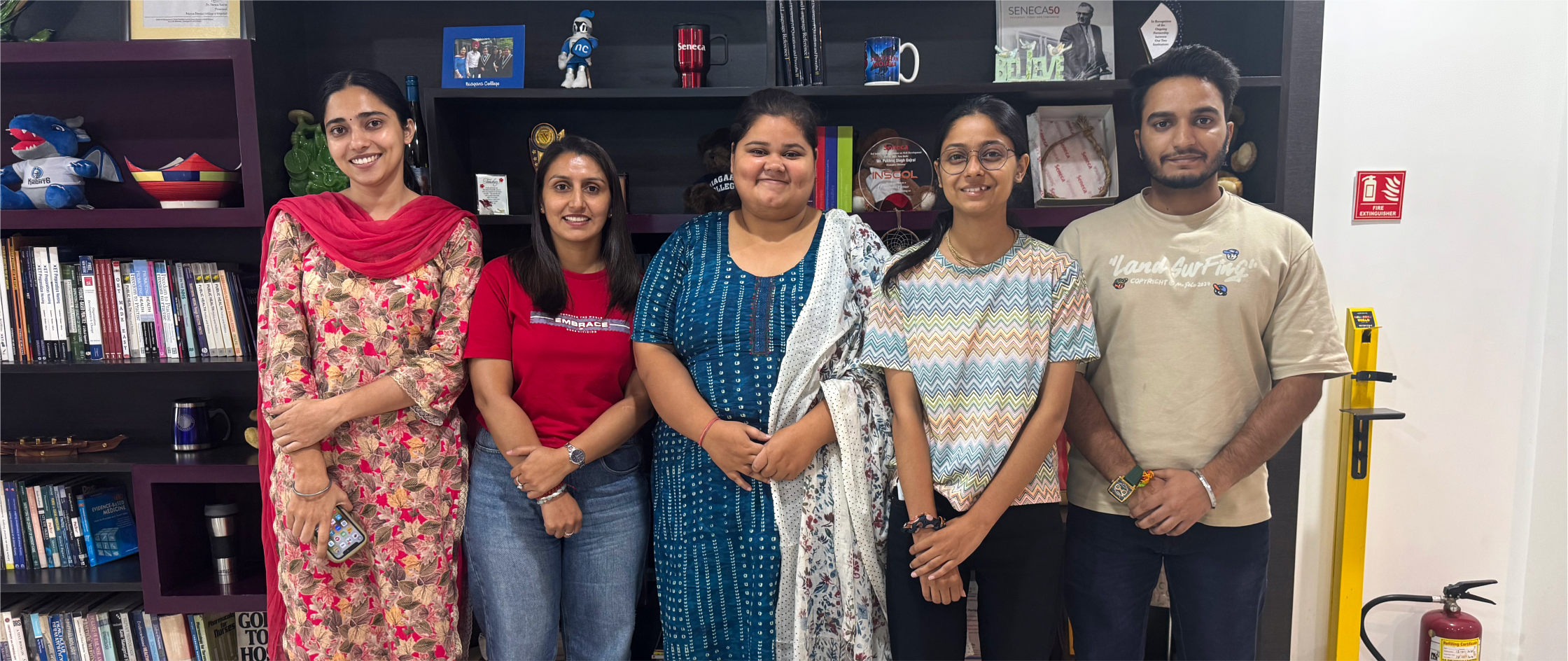
INSCOL Foundation Program for Sep'25 Intake
|
|
|
July 28, 2025: Here's a glimpse of a few future Global Nurses from our Chandigarh facility, after successfully
completing the INSCOL Foundation Program for the Sep'25 intake. Many others also joined us virtually from
across the globe, including the Philippines, Nigeria, and Ghana.
|
Pre-Departure Session at the Niagara College
Partnership Centre, Chandigarh
|

|
|
August 1, 2025: A comprehensive pre-departure session was held at the Niagara College Partnership Centre in
Chandigarh for nursing students joining the Sep'25 intake of specialized nursing programs at Niagara College,
Canada. Led by Gayatri Kochak, Global Business Development Officer - South Asia, the session provided
invaluable guidance to INSCOL nurses. Key topics included adapting to life in Canada, settling in smoothly, and
excelling as international students, ensuring they are well-prepared for their academic journey ahead.
|
|
|
Alumni Spotlight: Abigail's Journey
|
from Nigeria to a Registered Nurse in Canada
When Abigail first heard about INSCOL from a friend, she never imagined it would be the start of a life-changing journey. Today, she is a proud Registered Nurse in Ontario, Canada, with Permanent Residency status, and a story that can inspire countless Internationally Educated Nurses (IENs).
|

|
Discovering INSCOL and the Move to Canada
"I learned about INSCOL through a friend," Abigail shared. "After doing my research, I realized they were the best fit to help me pursue my dream of advancing my nursing career abroad."
For Abigail, studying in Canada wasn't just about academics. "I wanted to gain more knowledge in nursing, experience different cultures, and grow as a professional. Canada's strong education system felt like the right place for that."
Starting a New Life During a Pandemic
Abigail began her first program, Nursing Leadership and Management at Seneca Polytechnic in late 2019, just before the COVID-19 lockdown.
"It was tough," she recalls. “I was lucky to attend in-person classes for a couple of months, make some friends, and settle in. But then everything shifted online. It wasn't easy, but I'm grateful for those first two months of in-person learning."
She later completed her second program, Coronary Care Nursing, also at Seneca Polytechnic.
|
Adjusting to Life in Canada
Landing in Toronto during the cold month of December was an experience in itself. "I remember stepping out of the airport and thinking, "How am I going to survive this cold?" Abigail stated. But, with the help of a family friend, she slowly adjusted, found housing, navigated transit, and settled into her new routine.
Balancing Work and Study
As an international student, Abigail faced the challenge of working while studying, especially during COVID restrictions. "At first, for most of my first program, I didn't work because of COVID," she explained. "But once things eased, I started working as a Personal Support Worker (PSW). Since my classes were only twice a week, I could manage both work and school."
Balancing assignments with long shifts wasn't easy, but Abigail kept her focus clear. "Making good grades was always my priority," she said. "During COVID, essential workers were allowed to work full-time hours, so I worked full-time except for the days I had classes."
|

|
|
|
Support from INSCOL
Looking back, Abigail said that choosing INSCOL was one of the best decisions she made.
"They helped me pick the right programs, guided me through my applications, and even assisted me with the immigration process. I came to Canada in 2020 completely alone and didn't know anyone. It was difficult at first, especially when COVID happened, but their support made the entire journey easier."
From applying for her second program to extending her study permit and even securing her post-graduation work permit, INSCOL was by her side. "They handled so much of the process for me at no extra cost, so I could focus on my studies and career," Abigail added. "It's been a long journey with difficulties, but I overcame them. And today, as a Registered Nurse, I know it was all worth it."
|
Becoming a Registered Nurse
Five years later, Abigail is now a Registered Nurse at the Ontario Shores Centre for Mental Health Sciences, working as a float pool nurse across multiple units. The transition, she said, has been eye-opening.
"For one, the nurse-to-patient ratio here is so much better than back home, where we had more patients and fewer resources," she explained. "In Canada, patient care is truly a team effort. We have interprofessional rounds where everyone, meaning the nurses, doctors, therapists, share updates and collaborate to provide the best care."
The professional growth opportunities have also been a major advantage. "Here, there are resources that support your development. You can choose to go back to school, and part of your tuition is reimbursed," she added. "The working conditions are great, the compensation is fair, and most importantly, I have a healthy work-life balance."
Permanent Residency and Looking Ahead
In 2025, Abigail received her Canadian Permanent Residency, which is a milestone she calls "a huge sigh of relief." She's now looking forward to welcoming her family to Canada and showing them around, starting with Niagara Falls.
|

|
|
Advice for Aspiring IENs
To other nurses considering a similar path, Abigail offers simple but powerful advice:
"Go for it. Nurses and healthcare professionals are always in demand in Canada. The journey may have ups and downs, but in the end, you'll be grateful you took that step."
|
|
|